

A single bad review used to feel like a small bruise on your listing’s reputation. In 2026, it lands harder. Airbnb’s algorithm now leans on review sentiment and 5-star likelihood; the Guest Favorites badge demands near-perfect sub-scores; and Superhost status is reassessed every quarter. One messy review can quietly cost you bookings for months.
The good news: a thoughtful, public response can recover most of that ground — and sometimes win the next guest’s trust outright. This guide walks you through the modern playbook for hosts: when to respond, what to say, when to push for removal, and how to stop bad reviews from showing up in the first place.
Why a bad Airbnb review hits harder in 2026
Three things have changed since the early 2020s.
1. The algorithm cares about sentiment, not just averages
Airbnb’s 2025 search updates put two heavy weights on every listing: how likely a guest is to book, and how likely they are to leave a 5-star review. Recent reviews — and the language inside them — now shape ranking far more than your historical average.
2. Guest Favorites raised the bar
Airbnb’s Guest Favorites badge highlights the homes Airbnb considers most loved by guests.
According to Airbnb, eligibility is based on a mix of factors:
- Overall star rating
- The six category ratings (check-in, cleanliness, accuracy, host communication, location, value)
- Review removal rate
- Host cancellation rate
- Quality-related incidents reported to customer service
- A minimum of 5 reviews in the past 4 years (with at least 1 in the past 2 years)
Airbnb doesn’t publish a specific rating cutoff, but industry analysts who track the badge report that holders typically sit around 4.9+ overall with near-perfect sub-scores. Either way, a single 3-star review can knock a borderline listing out.
3. Superhost is now 4.8, reassessed quarterly
Current Superhost minimums are:
- 4.8 overall rating
- 90% response rate within 24 hours
- Under 1% cancellation rate
- 10+ completed stays in the past year (or 3 stays totaling 100+ nights)
Status is reviewed on January 1, April 1, July 1, and October 1.
Translation: in 2026, “average” sits around 4.75–4.8, not 4.7. Hosts in the 4.6–4.7 range are now treated as below average and lose visibility.
Wait. Then write.
Your first instinct after reading a 1-star review is almost always wrong. Take 24 hours. Re-read the review when you’re not flushed with adrenaline. The public-facing version of you is the one future guests will judge.
You don’t have to rush, either. Airbnb gives hosts 30 days to publicly respond to any review — plenty of time to draft, walk away, and come back. (The 14-day rule applies only to writing a review, not responding to one.)
While you wait, do three things:
- Pull up the booking and any messages, photos, or smart-lock logs from that stay.
- Check whether the review violates Airbnb’s review policy (we’ll get to that).
- Decide what outcome you actually want: an apology to a fair complaint, a calm correction to a misleading one, or a removal request.
The 5-step formula for responding to negative Airbnb reviews
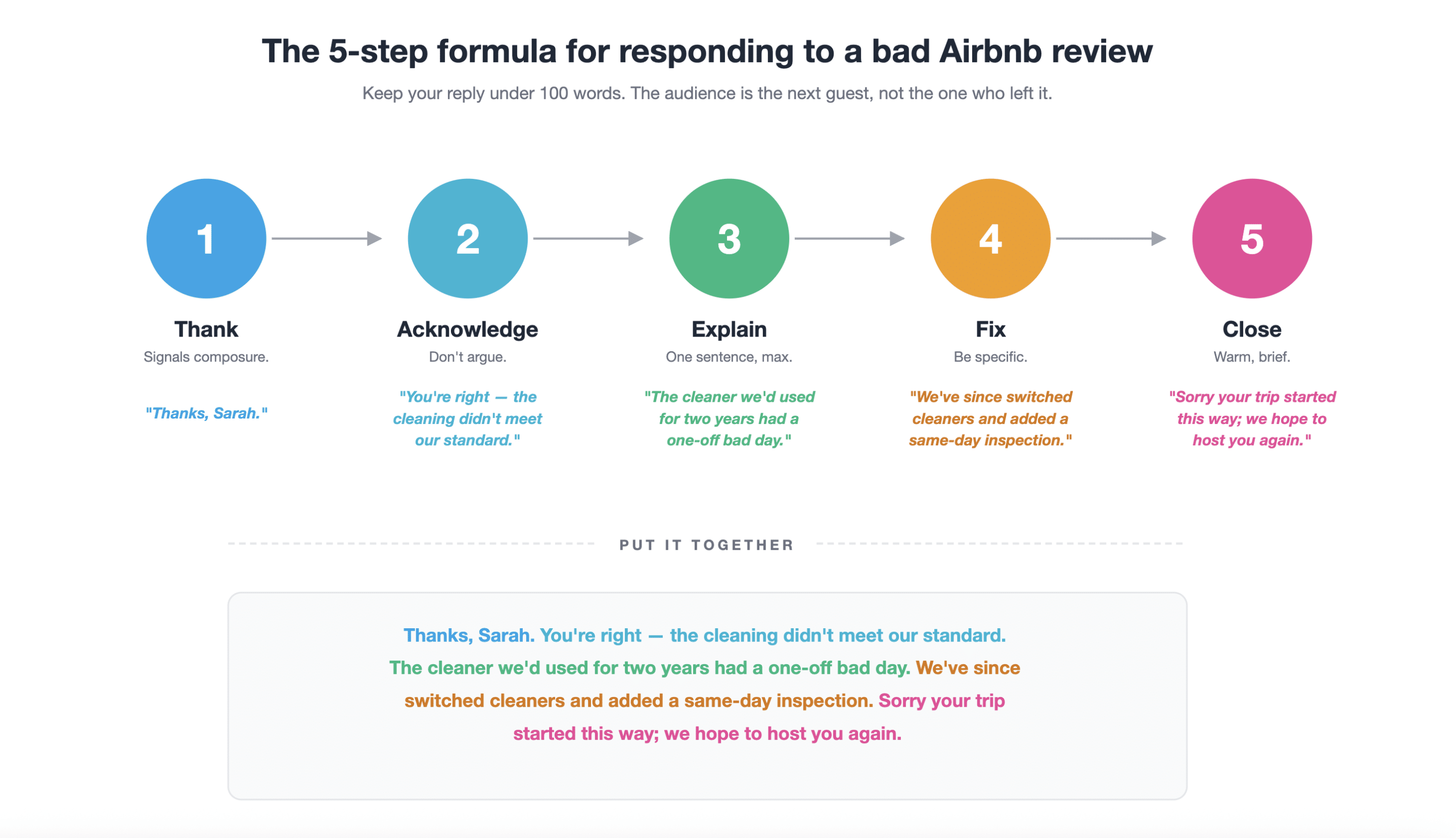
Every effective response does the same five things, in roughly the same order. Future guests are skim-readers — keep your reply under 100 words.
- Thank the guest. Two words: “Thanks, [Name].” It signals composure and disarms the reader.
- Acknowledge the issue without arguing. If it’s valid, say so. If it isn’t, name the experience without calling them a liar: “I’m sorry the stay didn’t meet expectations.”
- Briefly explain — once. One sentence of context, not three paragraphs of defense. Future guests stop reading the moment you sound defensive.
- State what you’ve changed (or offered). “We’ve replaced the mattress.” “We sent a partial refund the same day.” Specifics build trust with the next reader, who is the actual audience.
- Close warmly. “We appreciate the feedback” or “We hope to host you again” lands better than a cold sign-off.
Notice what the formula avoids: long apologies, blame, sarcasm, or rehashing the guest’s behavior. The response is for the next guest, not the one you just lost.
Response templates by review type
Pick the situation that fits, then make it yours.
A specific, valid complaint
“The house was dirty and the bathroom had bugs.”
Thanks for letting us know, Sarah. You’re right that the cleaning didn’t meet our standard — we’ve since replaced our turnover cleaner and added a mid-week pest treatment to the schedule. We’ve also sent you a partial refund. Sorry your trip started this way; we hope you’ll give us another chance.
“We waited an hour for someone to let us in.”
Thanks for the feedback, James. Our self-check-in instructions failed because of a battery issue with the smart lock — we’ve now switched to a hardwired lock and added a 24/7 backup contact in the welcome message. Sorry for the rough start.
“The apartment didn’t look like the photos.”
Thanks, Nina. The listing was photographed last spring, and a few details — the rug, the artwork — have changed since. We’ve reshot the listing this month so it reflects the current setup. Sorry it didn’t match what you booked.
A vague or generic negative review
“Wouldn’t book again.”
Thanks for taking the time to review, Alex. We’d love to know what fell short — feel free to message us directly so we can fix it. We’re constantly refining the place and your specifics would help.
“Not recommended.”
Thanks, Priya. A one-line review is hard to act on, but we take it seriously. If anything specific bothered you, please reach out — we’d genuinely like to make it right.
A 3-star “everything was fine”
“Stay was okay. 3 stars.”
Thanks for staying with us, Daniel. On Airbnb, anything below 5 stars signals a real issue, so a 3 tells us we missed somewhere obvious. If you’d share what would have made it a 5, we’d love to fix it for the next guest.
An unfair or retaliatory review
Don’t go to war in public. Stay short, factual, and let the contradiction speak for itself.
“Host kicked us out for no reason.”
Thanks for the review, Mark. For context, the booking was for two guests; we found seven people staying overnight on day three, which broke our occupancy and safety policies. We refunded the unused nights. We wish you better luck next time.
If a review breaks Airbnb’s rules — irrelevant, retaliatory, biased, or off-topic — request a removal before responding publicly. A public response can make removal harder.
When (and how) to dispute a review
Airbnb removes reviews that violate their content policy, but the bar is real and the process tightened in 2024–2025: hosts now get only two dispute attempts per review, and most cases are routed to automated triage.
Reviews that are usually eligible for removal:
- Retaliatory — the guest violated rules, you reported it, and the review reads like a response to that report.
- Biased — the review is about a thing the listing never claimed (the weather, neighborhood crime stats, road construction) or a circumstance fully outside your control.
- Irrelevant — the review is about the booking process, customer service, or someone else’s stay.
- Discriminatory or threatening — easy call.
- Extortion — the guest asked for a refund or favor in exchange for a positive review (save the messages).
How to dispute
- Open the review on the Airbnb host dashboard.
- Click “Report review” → choose the violation type.
- Submit your evidence in the first attempt: messages, smart-lock logs, photos, refund records. Be specific and short.
- If the first attempt fails and you have new evidence, you get one more shot. Don’t waste it on the same argument with new emotion.
If the review survives, fall back to a calm public response. Future guests can usually tell when a 1-star is unfair.
How Airbnb’s star rating actually works in 2026
Two things hosts get wrong: the categories and the math.
Airbnb has 6 sub-categories, not 8: cleanliness, accuracy, check-in, communication, location, and value. The “overall” rating is its own separate score, not an average of the six. “Amenities” isn’t a category at all.
The numbers that matter today:
- 4.9+ — required to be eligible for the Guest Favorites badge (top ~10% of listings), with near-perfect sub-scores and 5+ reviews in 24 months
- 4.8+ — Superhost minimum, reassessed quarterly
- ~4.75–4.8 — current platform average; “average” is now what 4.7 used to be
- Below 4.7 — visibility starts dropping in search
- Below 4.3 — listings risk soft removal or quality-team review
- One 3-star review on a fresh listing — can shift the average enough to lose Superhost or knock you off Guest Favorites; that’s why responding well matters
A single bad review is rarely fatal on its own. A pattern is.
Should you ever leave a bad review of a guest?
Yes — but rarely, and never out of revenge.
Hosts often soft-pedal guest reviews to avoid retaliation, which leaves the next host blind. If a guest broke house rules, sneaked in extra people, damaged the property, or treated your team badly, a calm, factual review helps the community.
A useful guest review is short, specific, and behavioral:
“Group brought additional guests not on the booking. Communication was difficult. Would not host again.”
Skip adjectives. Stick to facts you can document.
A few rules of thumb:
- Never mention disputes, refunds, or money in a public review (Airbnb may remove it).
- Don’t write reviews while angry.
- If you’re worried about retaliation, write your guest review on day 13 of the 14-day window, after they’ve likely already submitted theirs — Airbnb’s blind-review system means neither party sees the other’s review until both are in or 14 days have passed.
How to prevent bad Airbnb reviews in the first place
Most negative reviews are predictable. The hosts who avoid them aren’t lucky — they have systems.
- Onboarding messages that show up at the right moment. A pre-stay note 48 hours before arrival, a check-in confirmation the day of, a mid-stay nudge, and a thank-you on departure. Automate it once and forget it.
- Honest, current photos. If you replaced a sofa or repainted, reshoot the listing the same week.
- Pre-stay expectation setting. Mention what’s near (and what isn’t), how the noise sounds at night, where parking actually works.
- Friction-free check-in. A backup access method, working Wi-Fi, and a clear welcome guide solve most 1-star surprises.
- A response plan for issues mid-stay. Most “this stay was awful” reviews come from problems that weren’t addressed in the moment.
If you’re juggling more than a couple of listings, doing all of this manually is how things slip. A channel manager like Your.Rentals automates pre-stay messaging, syncs reviews across Airbnb, Booking.com, and Vrbo, and flags issues before they become star-rating events.
Frequently asked questions
How long do I have to respond to an Airbnb review?
30 days from the moment the review is published.
Can I delete a bad Airbnb review?
You can’t delete it yourself, but you can request removal if it violates Airbnb’s review policy (retaliatory, biased, irrelevant, discriminatory, or extortive). You get up to two dispute attempts.
What rating do I need to keep Superhost in 2026?
4.8 overall, plus a 90% 24-hour response rate, under 1% cancellations, and 10+ completed stays in the past year. Status is reviewed every January, April, July, and October.
What’s the Guest Favorites badge and how do I get it?
A badge for the top ~10% of listings. Minimums: 4.9+ overall rating, strong sub-scores, no recent serious issues, and at least five reviews in the past 24 months. Hosts with the badge typically see meaningfully more search exposure.
Does responding to a bad review actually help?
Yes — but the audience is the next guest, not the one
One inbox for every review
Manage Airbnb, Booking.com, and Vrbo reviews together. Respond faster, protect your rating, never miss a 1-star.
