

From September 27, 2026, new EU rules will change how businesses can make environmental and sustainability claims to consumers. And if you're a short-term rental host, it's worth checking your listing now.
The rules can apply to listings that are visible to or can be booked by people in the EU, even if the property itself is located somewhere else. So whether you're hosting in Spain, Bali, or Buenos Aires, it's worth taking a closer look at any claims about being eco-friendly, green, sustainable, or climate-friendly.
The new rules come from the EU's Empowering Consumers for the Green Transition Directive (ECGT), also known as the EmpCo Directive. The aim is to crack down on greenwashing and make sure consumers aren't being misled by environmental claims.
Here's what short-term rental hosts need to know.
What will change?
Generic green claims need to be backed up
Words such as "eco-friendly," "green," "sustainable," and "climate-friendly" can be a problem when they're used without explaining what they actually mean.
If you describe your property as sustainable, for example, you should be able to point to specific facts or evidence that support the claim.
A vague statement can be difficult to justify. A specific one is much easier.
Your own sustainability badge isn't enough
Have you added a home-made "green" badge or sustainability seal to your listing? That may not cut it under the new rules.
Environmental labels need to be based on a recognized certification scheme and meet the relevant requirements. Simply creating a badge for your property or business doesn't make an environmental claim more credible.
Certification needs to be independently verified
Not every environmental label automatically qualifies as proof of a green claim.
Certification schemes are expected to have clear and transparent requirements, with appropriate independent or third-party verification. In other words, an industry logo or self-created label isn't necessarily enough.
Be careful with future sustainability promises
Claims about what your property will achieve in the future also need substance behind them.
For example, saying "carbon neutral by 2030" shouldn't just be a marketing promise. You need a credible plan, measurable targets, and the appropriate monitoring or verification to support the claim.
Keep your claims up to date
Making a claim isn't a one-and-done exercise.
If you advertise your property as sustainable or energy-efficient, the information supporting that claim should remain accurate. That applies wherever the claim appears — from your short-term rental listing to your website and social media accounts.
There can be consequences for getting it wrong
This isn't simply about changing a few words on a listing.
National consumer protection authorities can take action against businesses that don't comply, and there are also routes for consumer organizations and competitors to challenge misleading practices.
What should short-term rental hosts do?
A quick review of your listing now can save you trouble later.
- Check your listing copy. Look at the property name, description, amenities, captions, and other text for environmental or sustainability claims.
- Look for visual claims too. Green badges, icons, logos, and sustainability symbols can also create an environmental claim.
- Ask what evidence you have. For every sustainability claim, could you show reliable evidence to support it if someone challenged it?
- Be more specific. Instead of a broad statement like "eco-friendly accommodation," explain the actual feature you're referring to — but only if it's accurate and you can support it.
- Consider recognized certification. If sustainability is an important part of your property's offering, an independently verified certification may provide stronger evidence than a claim you've created yourself.
- Keep your evidence current. Don't treat compliance as a one-time listing edit. Make sure the information behind your claims stays accurate over time.
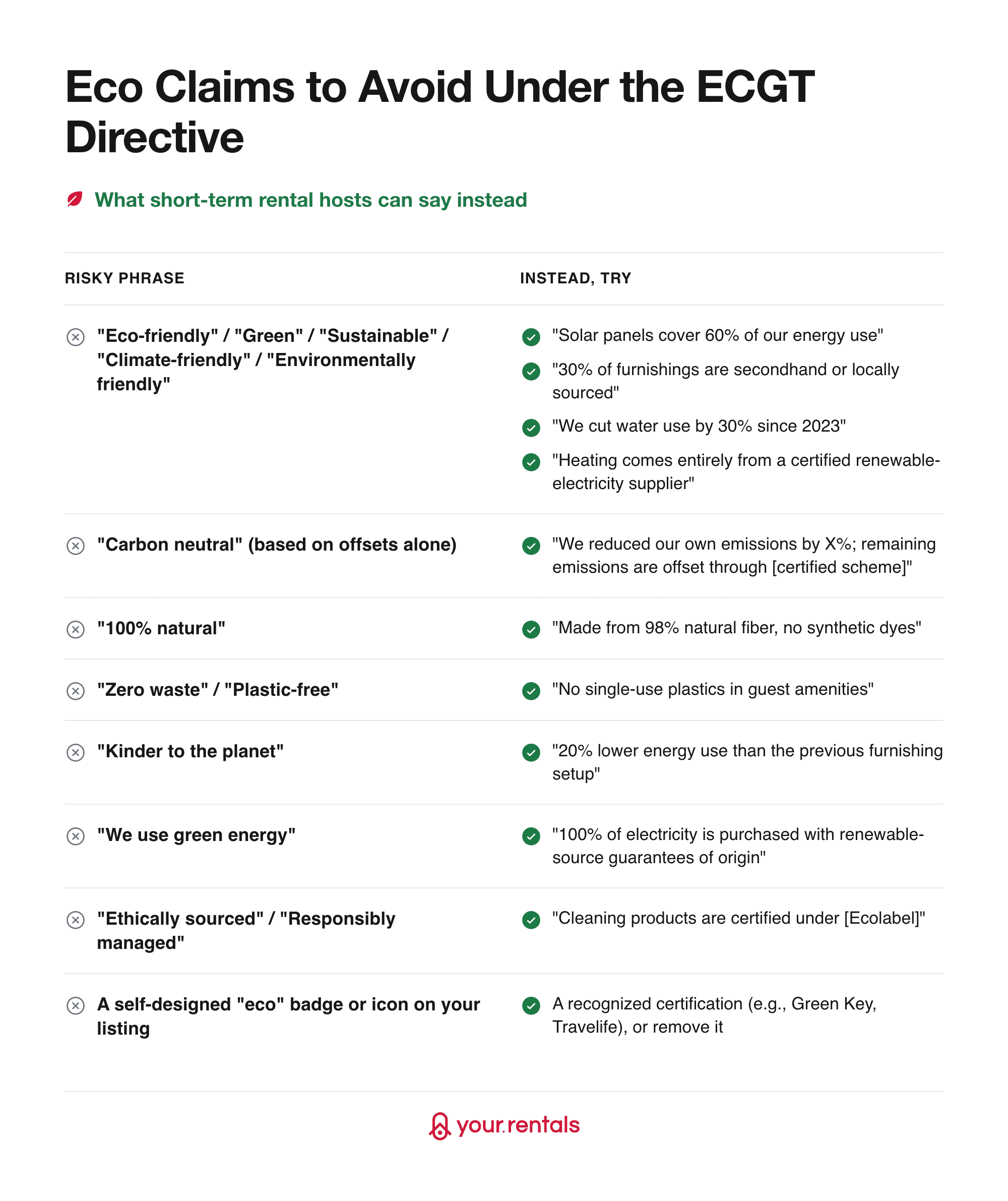
Treat the "instead, try" examples as templates — swap in your own real numbers and details rather than copying them as-is.
One thing that catches people off guard
The important factor isn't necessarily where your property is located. It's also who your listing is marketed or made available to.
A host in Bali or Buenos Aires whose short-term rental can be viewed or booked by consumers in the EU may still need to consider these rules. A property doesn't have to be physically located inside the EU for EU consumer rules to potentially become relevant.
If you're unsure whether the ECGT Directive applies to your particular business or how the rules affect a specific claim, get appropriate legal advice. This article is intended as a practical starting point for reviewing your listing, not as legal advice.
Your.Rentals has your back on compliance
Keep track of important regulatory changes without having to follow every update yourself. Your.Rentals can help you stay informed about rules that could affect your short-term rental business, including changes that may lead to fines or require updates to your listings.
Our support team is also here when you need help figuring out what a new regulation means for your day-to-day hosting.
Your.Rentals has your back on compliance
Get notified about critical rules that could mean fines, stay current on regulation updates, and count on our support team whenever you need help sorting things out.
